



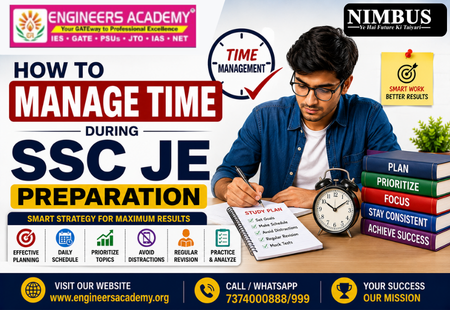
You don’t need to prepare for hours for the SSC Junior Engineer exam. It is about how you spent your time that counts. Students who get ready to learn enthusiastically work for 10-12 hours for a couple of days and can no longer sustain this pace. Others go on and on about one thing and then get stuck at the end of the syllabus.
It’s best to make a realistic timetable for your SSC JE exam preparation, break down the syllabus into smaller parts, and stick to a preparation routine.
Good time planning for all the students preparing for SSC JE Civil, Mechanical or Electrical can be very helpful in preparing. Here are some tips for arranging your preparations without stressing your everyday life.
Why is Time Management important for SSC JE Prep?
The SSC JE Syllabus is quite large, which spans technical subjects as well as non-technical ones. Along with studying the concepts, the candidates should also practice the previous year’s questions of SSC JE, solve numerical questions, edit the formulas, use practice papers, and analyze the errors.

Click Here: Join SSC JE Civil Online Course
Without a strategy it can be overwhelming to try and do it all. Good Time Management will assist you to:
- Systematically complete the SSC JE syllabus.
- Allow sufficient time for subjects other than technological.
- Practice questions regularly.
- Revise topics multiple times.
- Increase your speed and accuracy.
- Avoid last-minute pressure.
Make a realistic Study timetable for SSC JE
The first step towards good time management is to create a time agenda that you can follow.
One of the most common mistakes that the aspirants make is copying any other 12 hours study plan. Your schedule should depend on your level of preparation, the amount of time you can dedicate, your daily responsibilities and how fast you can learn.
If you can study for 6-8 hours at a time for a period of time without any breaks, then do not attempt to study for 12 hours. It’s better to have a regular routine over the course of a few months than to dive into some unrealistic routine in one week.

Click Here: Join SSC JE Electrical Online Classes
Sample SSC JE Daily Study Routine may look like this:
Divide Your Time between Technical and Non-Technical Subjects
Technical subjects generally have to be prepared for a lot of time as they involve various concepts, formulas, numerical problems and previous year questions etc.
But candidates are not supposed to leave non-technical sections till the end.
Rather, stick to a normal schedule. For instance, if you are strong in technical subjects, you can invest 60-70% of your study time in technical subjects and 30% of your time in the non-technical preparation.

Click Here: Join SSC JE Mechanical Online Classes
This can be subjects like Strength of Materials, Fluid Mechanics, RCC, Soil Mechanics, Environmental Engineering and other topics of the syllabus for civil engineering aspirants.
Similarly, Mechanical and Electrical Engineering aspirants can split their technical preparation based on the weightage and difficulty of their subjects.
The key to it is to not spend all of your preparation period learning just your favourite subject.
Give Priority to SSC JE Previous Year Questions
One of the most beneficial resources to be used in preparation is the SSC JE Previous year Questions as it would give you an idea about the type of questions asked in the examination.
You are not required to complete the whole syllabus first and then start doing PYQs.You don’t have to read the entire syllabus first and then do PYQs.
When finished with a topic, answer last year’s questions. This will help you to grasp:
- The concepts that are being asked over and over.
- What should be practiced more.
- How questions are framed.
- What mistakes you are making.
- How much time you are taking to solve questions.
Keep a separate book or notes of questions that you miss. It can save a lot of time when revising if these mistakes were remembered.
Apply the 80/20 Principle in Revision
Towards the end of the exam period, there is no time to allocate the same amount of time to each topic.
Some questions are more significant, some are asked again and again and some are your own particular weak areas. This should be reflected in your revision plans.
One way to do this is to categorize topics into three groups:
This will save a few hours of time from reworking topics you already know well, but neglecting topics that could boost your score.
How to manage time in the last few months of SSC JE Exam Preparation?
As you get nearer to the final exam, your strategy needs to gradually shift from being a learner to a reviser, from being a learner of new concepts to a reviser of them, from being a learner of new PYQs to a reviser of them, from being a learner of new Mock tests to a reviser of them, and from being a learner to a performance improver.
Avoid using new books, courses, notes and study materials during the final period. If a range of resources are being used they can cause confusion and be a time consuming preparation tool. Instead, focus on the resources you already have and practice them to build them up.
FAQs
- How many hours should I need to study for SSC JE daily?
Effort and not hours. The quality and uniformity in your study is more important. Study for 6-8 hours and give focused attention rather than 12 hours of study and distractions. Make a schedule that you can stick to for several months.
- When should I start solving SSC JE previous year question papers?
As each topic/chapter is covered, one should start the PYQs. It is not necessary to complete all of the syllabus. By practicing PYQs on a topic-wise basis, you can get an idea about how the exam is structured and which concepts are crucial.
- What are the best time management techniques for SSC JE?
Make a sensible daily schedule, make a plan for preparation for technical and non-technical subjects, set clear daily goals, practice regularly set questions and review mock tests. Most important, don’t devote too much attention to one topic at the expense of another, which is included in the syllabus.