



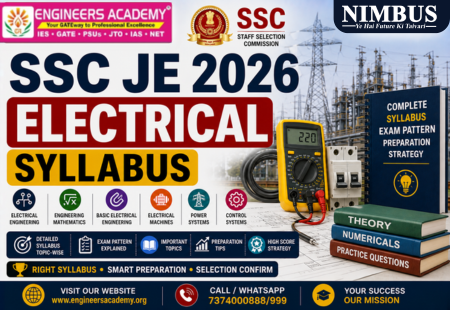
The key step in preparing for the Staff Selection Commission Junior Engineer (SSC JE) exam is to thoroughly understand the SSC JE exam syllabus. Every year, thousands of engineering graduates compete for the SSC JE posts, but a few of them who prepare systematically are the winners. The SSC JE Electrical Syllabus 2026 serves as a guide for your preparation, enabling you to focus on key topics and allocate your study time efficiently.
The SSC JE Electrical Engineering Syllabus 2026 mainly consists of the Diploma-level Electrical Engineering Syllabus and General Intelligence & Reasoning and General Awareness. The complete SSC JE Syllabus 2026, Electrical Engineering topics to study, and how a coaching institute like the Engineers Academy boosts your preparation with exam-oriented study material are explained in this comprehensive guide.
Why Understanding the SSC JE Syllabus 2026 is Important
Many of the candidates start their preparation without understanding the syllabus and buy several books or watch a lot of lectures on the internet. This can result in wasted effort and incomplete preparation.
By knowing the SSC JE 2026 syllabus, candidates know:
- Which topics to prepare that are relevant to the exam.
- Develop a good study plan.
- Identify high-weightage subjects.
- Improve revision planning.
SSC JE 2026 Exam Pattern
Paper I evaluates both technical and non-technical knowledge, whereas Paper II is entirely focused on electrical engineering concepts. The current structure of the examination includes a technical paper dedicated to the candidate’s engineering discipline.
SSC JE Electrical Engineering Syllabus 2026 (Topic-Wise)
The SSC JE Electrical Engineering Syllabus 2026 covers diploma-level engineering concepts that test both theoretical knowledge and numerical aptitude.
- Basic Electrical Concepts
This section forms the foundation of electrical engineering and includes:
- Ohm’s Law
- Kirchhoff’s Laws
- Circuit Elements
- Network Theorems
- Series & Parallel Circuits
- Electrical Energy and Power
- Circuit Theory & AC Fundamentals
Candidates should prepare:
- AC Fundamentals
- RLC Circuits
- Resonance
- Power Factor
- Three-Phase Circuits
- Magnetic Circuits
- Transients
Numerical questions from these topics are commonly asked in the examination.
- Electrical Machines
Electrical Machines remain one of the highest-scoring sections of the SSC JE Electrical Syllabus 2026.
Important topics include:
- DC Machines
- Transformers
- Induction Motors
- Synchronous Machines
- Special Purpose Motors
- Fractional Kilowatt Motors
- Motor Characteristics
- Power Systems
Prepare the following concepts thoroughly:
- Generation of Electrical Energy
- Transmission Systems
- Distribution Systems
- Substations
- Switchgear
- Protection Systems
- Circuit Breakers
- Relays
- Measurement & Measuring Instruments
Important topics include:
- Electrical Measurements
- Moving Coil Instruments
- Moving Iron Instruments
- Wattmeter
- Energy Meter
- Bridges
- Instrument Transformers
- Errors in Measurement
- Estimation & Costing
Candidates should study:
- Estimation of Electrical Installations
- Earthing Practices
- Wiring Systems
- Lighting Design
- IE Rules
- Safety Standards
- Utilization of Electrical Energy
This section includes:
- Illumination
- Electric Heating
- Electric Welding
- Electric Drives
- Electroplating
- Electric Traction
- Basic Electronics
The electronics portion generally includes:
- PN Junction Diode
- Rectifiers
- Transistors
- Logic Gates
- Semiconductor Devices
- Amplifiers
- Basic Digital Electronics
These subjects consistently form the core of the SSC JE Electrical Engineering Syllabus 2026.
Important Topics to Prioritize
Although every topic in the SSC JE Syllabus 2026 is important, some areas frequently contribute a significant number of questions.
How Engineers Academy Can Help You Crack SSC JE
Preparing for SSC JE becomes much easier when you study from top coaching faculties in the country. Engineers Academy offers exam-oriented study material that aligns with the SSC JE Electrical Syllabus 2026 and covers both conceptual learning and practice.
The study material is designed to help aspirants:
- Cover the complete syllabus systematically.
- Practice chapter-wise MCQs.
- Solve previous year questions with detailed explanations.
- Strengthen conceptual understanding.
- Improve speed and accuracy through exam-level practice
Instead of referring to multiple sources, candidates can rely on structured resources from Engineers Academy’s coaching publications, the EA Publications, for focused preparation.
Conclusion
The SSC JE Electrical Syllabus 2026 is a comprehensive guide that outlines the exam pattern and curriculum, helping candidates prepare effectively for the position of Junior Engineer with the Staff Selection Commission. By mastering the SSC JE Electrical Engineering Syllabus 2026 and adopting a systematic approach, you can significantly boost your chances of success. With diligent study, regular revision, and consistent practice, you can improve your chances of success significantly after mastering the SSC JE Electrical Engineering Syllabus 2026.
The SSC JE 2026 syllabus is easily completable with the help of the quality study material provided by EA Publications and a proper preparation strategy.
FAQs
- What is included in SSC JE Electrical Syllabus 2026?
The SSC JE Electrical Syllabus 2026 comprises General Intelligence & Reasoning, General Awareness, and Electrical Engineering, which are divided into Circuit Theory, Electrical Machines, Power Systems, Measurements, Basic Electronics, Estimation & Costing, and Utilization of Electrical Energy.
- What is the minimum qualification to apply for the SSC JE Electrical Engineering Syllabus 2026 exam?
Yes. The SSC JE Electrical Engineering Syllabus 2026 is mainly related to the concepts of diploma-level engineering, so conceptual clarity is equally significant, and practice of numbers is significant too.
- What are the best books to follow to cover the SSC JE 2026 syllabus?
A candidate should select books for the competitive exam that cover the whole SSC JE 2026 syllabus, include questions provided chapter-wise, previous year questions and detailed answers.